OMOLOLA TALKSTV YÀRÁ ÌKẸ́KỌ̀Ọ́
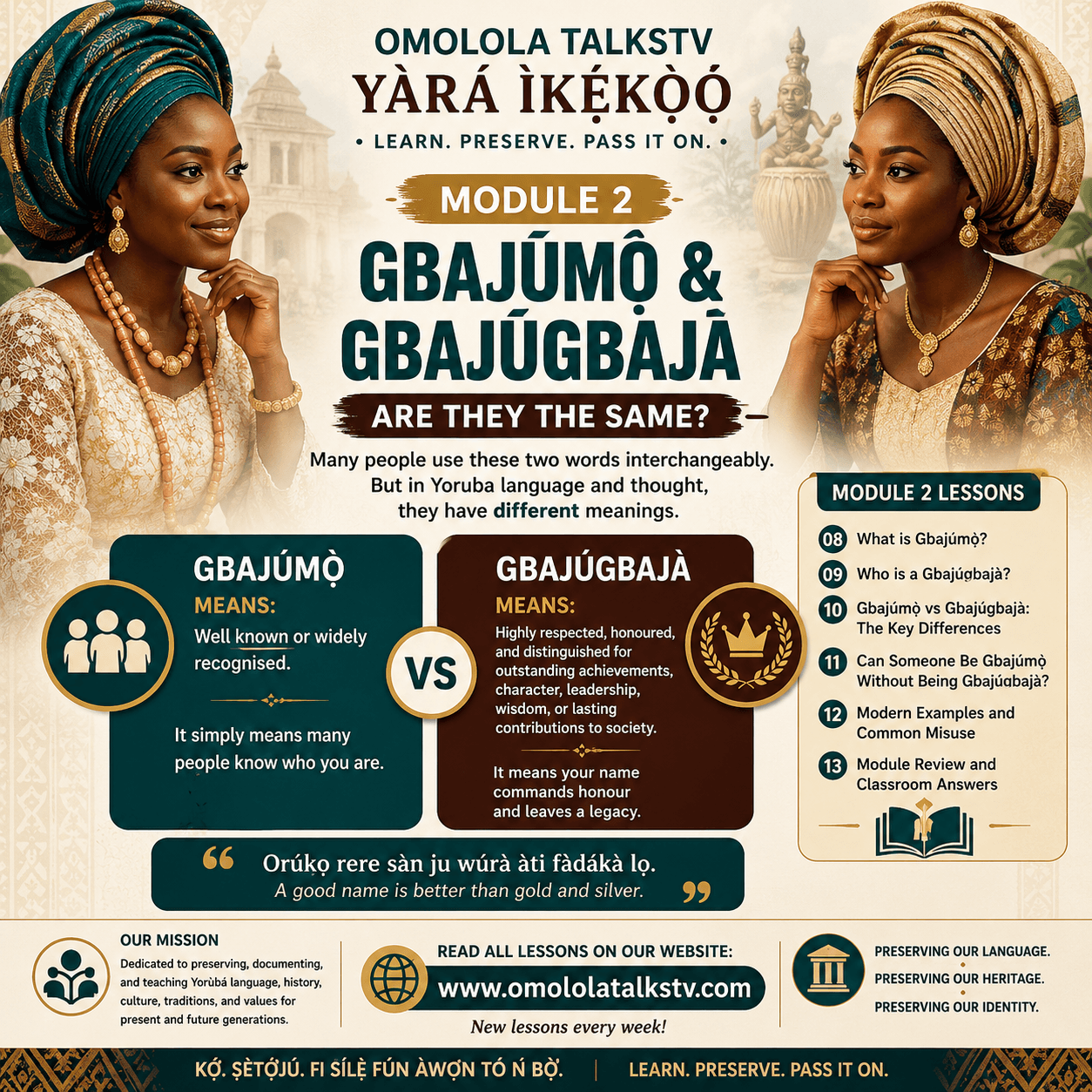
MODULE 2 – GBAJÚMỌ̀ & GBAJÚGBAJÀ
Lesson 012
When Do We Misuse Gbajúmọ̀ and Gbajúgbajà?
Ẹ káàbọ̀ sí Omolola TalksTV Yàrá Ìkẹ́kọ̀ọ́.
Before we conclude this module, let us talk about something that happens almost every day.
Many of us use the words Gbajúmọ̀ and Gbajúgbajà as though they mean exactly the same thing.
Sometimes we hear people say,
"Ó jẹ́ ènìyàn gbajúgbajà."
What they actually mean is that the person is simply well known.
At other times, someone who has spent decades serving society with honour and distinction is described merely as Gbajúmọ̀, even though Gbajúgbajà would better express the respect they have earned
This is one of the reasons we started Omolola TalksTV Yàrá Ìkẹ́kọ̀ọ́.
Words matter.
When we understand the true meaning of our language, we preserve not only our vocabulary but also the wisdom of our ancestors.
Let Us Consider Two Examples
Imagine a young musician whose songs suddenly become popular across the country.
Millions of people know the person's name.
The musician is Gbajúmọ̀.
Now, think of a respected professor who has spent forty years teaching, mentoring students, writing books, and contributing to education.
That person may not appear on social media every day.
Yet their name commands honour whereverit is mentioned.
Such a person may rightly be described as Gbajúgbajà.
Neither word is greater than the other.
They simply describe different things.
One speaks about being widely known.
The other speaks about being widely respected.
Sometimes, one person may be both.
Our generation often celebrates popularity.
Yoruba culture reminds us to celebrate purpose, character, and lasting contribution.
Popularity may open doors.
Character determines whether those doors remain open.
Perhaps that is why our ancestors valued a good name above temporary applause.
Classroom Question
Can you think of someone who is both Gbajúmọ̀ and Gbajúgbajà?
Tell us why you think so.
There is no single correct answer.
We look forward to reading your thoughts.
Editor's Note
Yorùbá language, titles, and customs may vary across different kingdoms and communities. Omolola TalksTV presents the most widely accepted understanding while respectfully acknowledging regional differences where they exist.
Omolola TalksTV Yàrá Ìkẹ́kọ̀ọ́
Dedicated to preserving, documenting, and teaching Yorùbá language, history, culture, traditions, and values for present and future generations.
Our Mission
Kọ́. Ṣètọ́jú. Fi sílẹ̀ fún àwọn tó ń bọ̀.
Learn. Preserve. Pass It On.