OMOLOLA TALKSTV YÀRÁ ÌKẸ́KỌ̀Ọ́
MODULE 3 – OLÓYÈ & ÌJOYÈ
Lesson 016
Who Is an Ìjoyè? More Than a Traditional Title
Ẹ káàbọ̀ sí Omolola TalksTV Yàrá Ìkẹ́kọ̀ọ́.
In our previous lesson, we looked at the word Olóyè and discovered that it is more than a title. It represents honour, responsibility, and service to the community.
Today, let us look at another word that is often mentioned alongside it.
Who is an Ìjoyè?
If you have attended a traditional installation ceremony before, you may have heard someone say,
"Ó jẹ́ Ìjoyè ní ìlú wa."
Many people immediately think it means exactly the same thing as Olóyè.
The relationship between the two words is close, but like many expressions in the Yoruba language, understanding them requires looking beyond a simple translation.
Understanding the Word
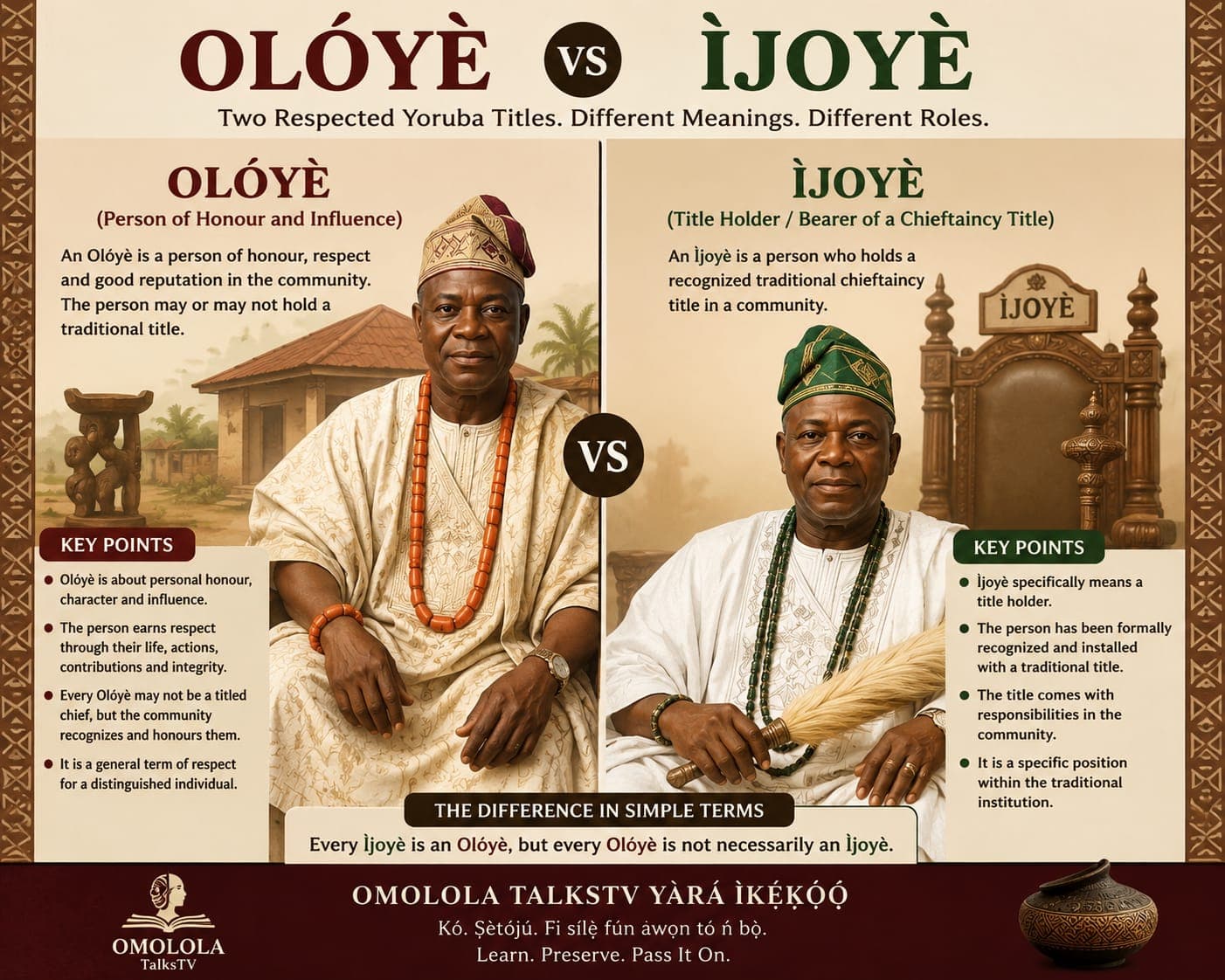
In many Yoruba communities today, Ìjoyè is commonly used to describe a person who has been formally installed into a recognised traditional chieftaincy title.
In other words, the word often emphasises the recognised status of the individual within the traditional institution.
This is one reason many people use Olóyè and Ìjoyè interchangeably.
However, depending on the kingdom or community, the way these words are used may differ slightly.
That is part of the richness of the Yoruba language.
Why Context Matters
One of the beautiful things about Yoruba culture is that not every kingdom uses titles in exactly the same way.
What is common practice in one town may be different in another.
Rather than seeing these differences as contradictions, we should see them as evidence of the diversity that exists within Yorubaland.
The important lesson is not to argue over which community is right.
The important lesson is to understand the context in which the words are being used.
A Lesson from Our Ancestors
Whether someone is described as an Olóyè or an Ìjoyè, one thing remains constant.
A traditional title was never intended to be an ornament.
It was a call to serve.
Our ancestors believed that honour should always be accompanied by responsibility.
That lesson is still relevant today.
Classroom Question
Why do you think Yoruba traditional institutions place so much emphasis on responsibility rather than privilege?
There is no single correct answer.
Reflect on it before we continue to our next lesson.
Editor's Note
The understanding and use of traditional titles may vary across different Yoruba kingdoms and communities. This lesson presents the most widely accepted understanding while respectfully acknowledging those variations.
Omolola TalksTV Yàrá Ìkẹ́kọ̀ọ́
Dedicated to preserving, documenting, and teaching Yorùbá language, history, culture, traditions, and values for present and future generations.
Our Mission
Kọ́. Ṣètọ́jú. Fi sílẹ̀ fún àwọn tó ń bọ̀.
Learn. Preserve. Pass It On.