Spirit or supernatural being, Egbére is part of the rich tapestry of Yoruba folklore and spiritual cosmology. It is commonly described as a wandering forest spirit, mysterious, pitiful, and deeply symbolic. Here is what traditional belief teaches about Egbére.
🌒 Description and Nature of Egbére
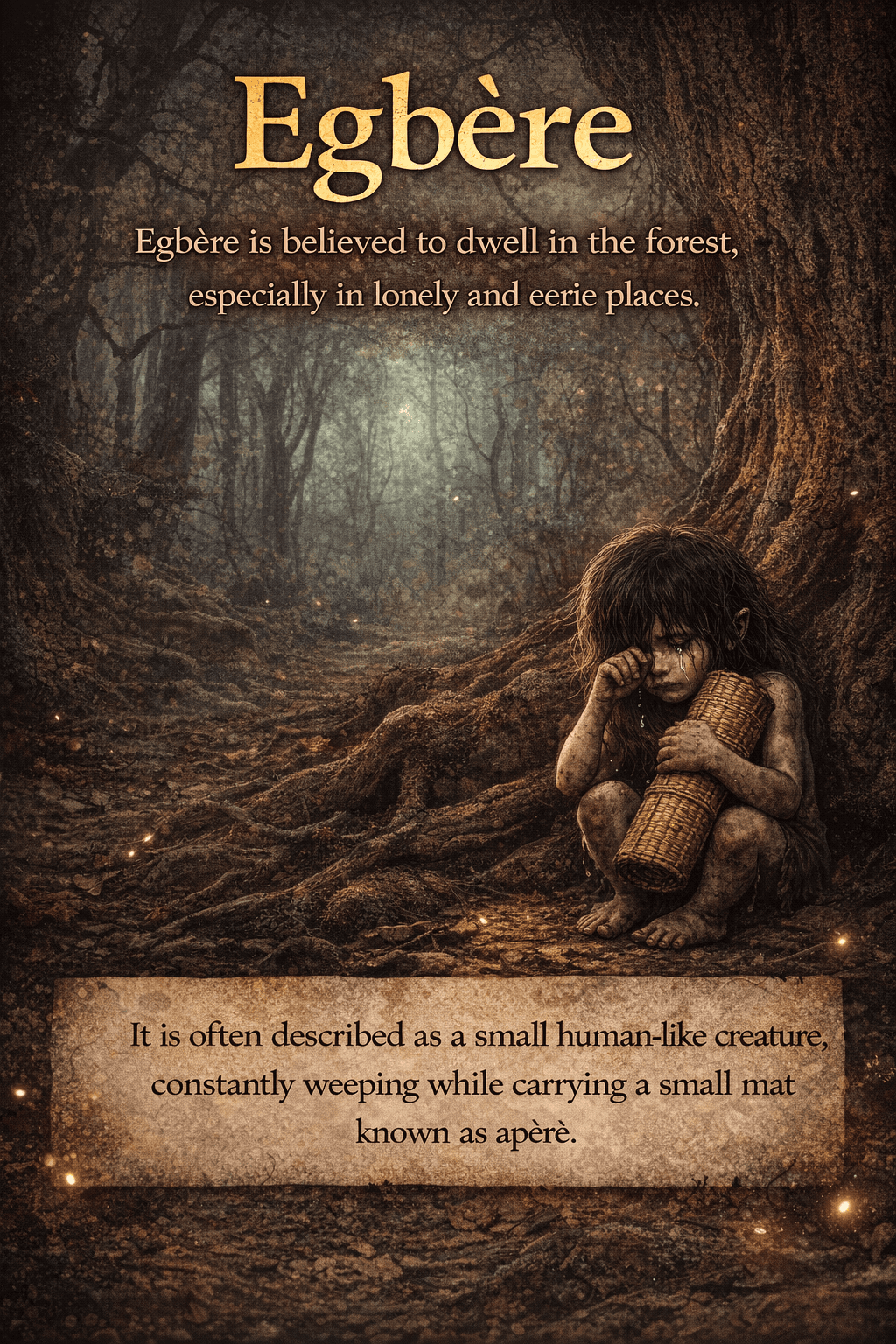
Egbére believed to dwell in the forest, especially in lonely and eerie places. It is often described as a small human-like creature, constantly weeping while carrying a small mat known as apèrè.
Many say its sorrowful cries can be heard at night, especially deep within the bush. The sound is said to be haunting, a long, painful wail that unsettles anyone who hears it.
🧺 The Mysterious Mat, Apèrè Egbére
One of the most well-known aspects of the Egbére story is the mat it carries. According to traditional belief, this mat holds immense spiritual power and hidden wealth.
It is said that anyone who can seize Egbére's mat and keep it for seven days without dying will become extraordinarily rich. But this is nearly impossible. Egbére will cry relentlessly and unleash terrible misfortune in an attempt to reclaim it. Many stories warn that those who try to keep the mat often go mad or die before the seven days are complete.
👻 Spiritual Meaning
Egbére is widely seen as a symbol of sorrow, greed, and the unseen spiritual realm. Yoruba elders often describe it as one of the wandering spirits, ẹ̀mí àìnílé, souls that have not found rest.
The story serves as a warning about greed. The temptation of the mat represents the human desire for quick wealth, but that desire leads only to destruction. In another interpretation, Ègbérè embodies loneliness and unfulfilled destiny, which explains its endless weeping.
🪶 Is Egbére Real
In traditional Yoruba cosmology, Ègbérè is real in a spiritual sense. It belongs to the invisible realm, ayé àti ọ̀run, the seen and unseen worlds that coexist.
Elders say certain powerful Babaláwo, priests of Ifá, or experienced hunters known as ọdẹ, may encounter it. From a modern perspective, many people regard Egbére as folklore or a moral tale rather than a physical being. However, within Yoruba spirituality, it exists as part of the spirit world, much like the spirits associated with rivers, hills, or revered ancestors.
🗣️ Common Sayings
Má gba apèrè Egbére
Do not take Egbére’s ’s mat. This is a warning against greed.
Egbére ń sunkún, kò mọ̀ pé ayé ń rẹ́rìn-ín.
Egbére cries, unaware that the world is laughing. This proverb speaks about hidden sorrow and the loneliness of suffering.
🪶 Ìtàn Egbére àti Adégboyè
Egbère… Egbère…
The Tale of Egbére and Adégboyè
Long ago, in a small Yoruba village near a thick forest, there lived a poor hunter named Adégboyè. He worked tirelessly, yet no matter how much he hunted, he could not earn enough to properly care for his wife and children.
Each night, he ventured deep into the forest, setting traps and calling upon Ògún, the deity of iron and hunters, to guide and bless his path.
🌒 One Night in the Forest
On a moonless night, Adégboyè heard a strange and sorrowful cry.
“Egbére … Egbére wáàá…”
Drawn by curiosity, he followed the sound until he saw a small creature sitting beside a fallen tree. It wept bitterly, clutching a tiny mat. The being was no taller than a child, with hair like dry grass and eyes that glowed faintly in the darkness.
💰 The Temptation
Hidden behind a tree, Adégboyè remembered the words of the elders.
Whoever takes the mat of Egbére and keeps it for seven days will become rich forever.
Greed slowly crept into his heart. When the creature briefly set the mat down, he rushed forward and seized it.
Egbére let out a piercing scream that shook the trees. It chased him through the forest, crying,
Fún mi ni apèrè
mi o. Fún mi ni apèrè mi.
Give me back my mat.
But Adégboyè ran until he reached his home.
🌩️ The Seven Nights of Terror
That night, thunder roared, though the sky was clear. Strange footsteps circled his house. Every night, they heard the cry outside.
Adégboyè, fún mi ni àpẹ̀rẹ̀ mi o.
His children fell ill. His goats died mysteriously. Shadows flickered in the corners of the hut.
By the sixth night, Adégboyè "was nearly mad with fear, yet he refused to return the mat. He thought only of the wealth that was promised.
⚰️ The Seventh Night
At midnight, a fierce wind shook the hut. Egbére appeared at the doorway, its eyes red, tears flowing like rain.
“You have taken my sorrow,” it said. “Now you will carry it.”
It touched Adégboyè's chest. He collapsed, weeping uncontrollably, just like Egbére
By morning, the villagers found him clutching the mat, crying without end.
🪶 The Lesson
From that day, the elders would say,
Má gba ohun tí kì í ṣe tirẹ̀.
Do not take what does not belong to you.
Owó egbére kì í mú ẹni l’áyọ̀.
The wealth of Egbére never brings true joy.
The story reminds us that greed brings sorrow and that not all riches are meant to be taken. And they say that somewhere deep in the forest, Egbére still roams, weeping softly, holding its mat, searching for peace.
✍️
Omo'ba Omoluabi Omólola Adepeju