Is It Time for Nigeria to Revisit Regional Governance?
By Omolola Talkstv
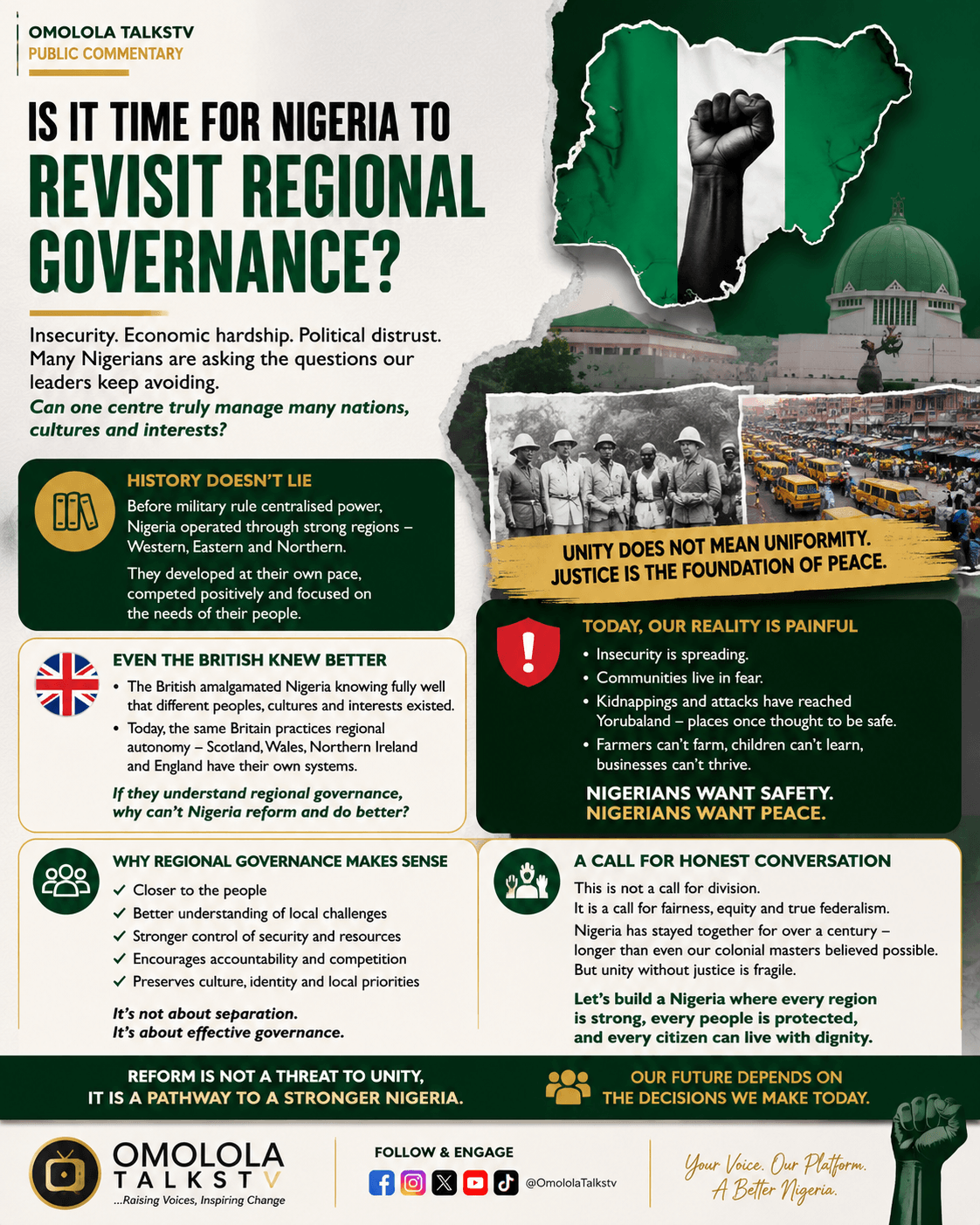
As insecurity continues to spread across different parts of Nigeria, many citizens are beginning to ask difficult questions about the structure of the country itself.
From kidnappings to attacks on rural communities, from economic hardship to growing distrust in leadership, many Nigerians no longer feel safe or properly represented under the current centralized system of governance.
For many people in the South West, the recent security concerns in places once considered relatively peaceful have become deeply unsettling. Communities in Yorubaland that once believed in insecurity were “far away” and are now beginning to experience fear more directly.
This is why conversations around restructuring and regional governance are gradually returning to public discourse again.
Historically, Nigeria once operated under a stronger regional system. The Western, Eastern, and Northern Regions had greater control over development, agriculture, education, and local priorities. Many historians argue that the regions competed positively and developed according to their strengths.
Even the British colonial administration that amalgamated Nigeria in 1914 understood the complexity of governing many nations, cultures, and interests under one structure. Ironically, the same Britain today practices a form of regional autonomy through Scotland, Wales, Northern Ireland, and England, each with varying degrees of local control.
This raises an important question:
If even the colonial masters recognized the importance of regional identity and autonomy, why is Nigeria still afraid of serious constitutional reforms?
For over a century, Nigerians have remained together despite ethnic, religious, and political tensions. That alone is remarkable. But unity without fairness, security, accountability, and local empowerment will always remain fragile.
This does not mean division or hatred toward any ethnic group. Nigeria belongs to all its citizens. However, many people now believe that regions should have stronger control over their security, resources, development priorities, and internal affairs while still remaining part of one nation.
The reality is simple:
people want safety.
Parents want to travel without fear. Farmers want to return to their farms. Children deserve to grow without trauma. Communities want to sleep peacefully again.
Whether through restructuring, true federalism, or stronger regional autonomy, Nigeria must begin to have honest conversations about governance without pretending everything is normal.
Because silence does not solve insecurity.
Perhaps one of the greatest mistakes any society can make is waiting too long before reforming what is clearly no longer working properly.