OMOLOLA TALKSTV YÀRÁ ÌKẸ́KỌ̀Ọ́
MODULE 3 – OLÓYÈ & ÌJOYÈ
Lesson 014
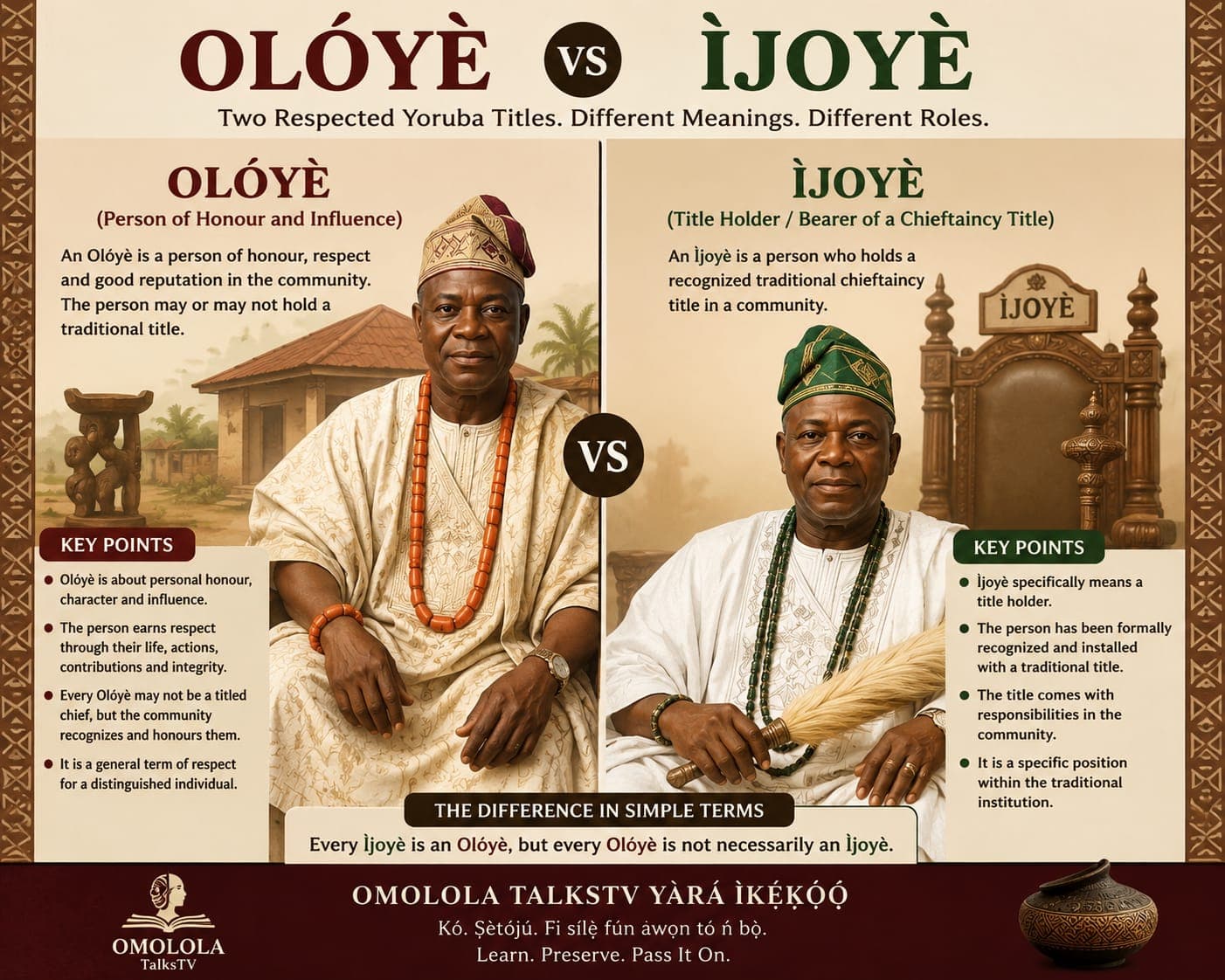
Olóyè and Ìjoyè: Are They Really the Same?
Ẹ káàbọ̀ sí Omolola TalksTV Yàrá Ìkẹ́kọ̀ọ́.
In our previous module, we discovered that Gbajúmọ̀ and Gbajúgbajà are not exactly the same, even though many people use them interchangeably.
Today, we are looking at another pair of Yoruba words that often cause confusion Olóyè "and Ìjoyè.
If you attend a traditional wedding, a chieftaincy ceremony, or even a funeral in Yorubaland, you will probably hear someone say:
"Ẹ jẹ́ kí àwọn Olóyè jókòó sí iwájú."
At another event, someone may introduce a guest as:
"Ó jẹ́ Ìjoyè ní ìlú wa."
Many people hear these expressions and assume they mean exactly the same thing.
But do they?
That is the journey we begin today.
Why Does This Matter?
Some people believe that once a person receives a traditional title, they automatically become an Olóyè.
Others use Ìjoyè and Olóyè as though they are two different names for the same thing.
The truth is that Yoruba traditional institutions are rich, organised, and deeply rooted in history.
Because of that, every title has its own meaning and place.
If we truly want to preserve our culture, we must also preserve the meaning of the words that describe it.
Before We Define the Words...
Rather than rushing to definitions, let us first understand something important.
Yoruba traditional titles are not merely decorations.
They are symbols of responsibility.
They represent service.
They represent trust.
They connect today's generation with the wisdom of those who came before us.
That is why understanding these words is more than a language lesson.
It is a lesson about our identity.
In our next lesson, we shall begin by asking a simple question:
Who is an Olóyè?
You may be surprised that the answer is broader than many people think.
Classroom Question
Before reading Lesson 015, answer this question:
Have you always believed that Olóyè and Ìjoyè mean the same thing? If yes, what made you think so?
There is no right or wrong answer.
We simply want to hear your thoughts before we continue this journey together.
Editor's Note
Yorùbá "traditional "titles and "customs may "vary" across different "kingdoms and communities " Throughout this module, Omolola TalksTV presents the most widely accepted understanding while respectfully acknowledging regional differences where they exist.
Omolola TalksTV Yàrá Ìkẹ́kọ̀ọ́
Dedicated to preserving, documenting, and teaching Yorùbá language, history, culture, traditions, and values for present and future generations.
Our Mission
Kọ́. Ṣètọ́jú. Fi sílẹ̀ fún àwọn tó ń bọ̀.
Learn. Preserve. Pass It On.