
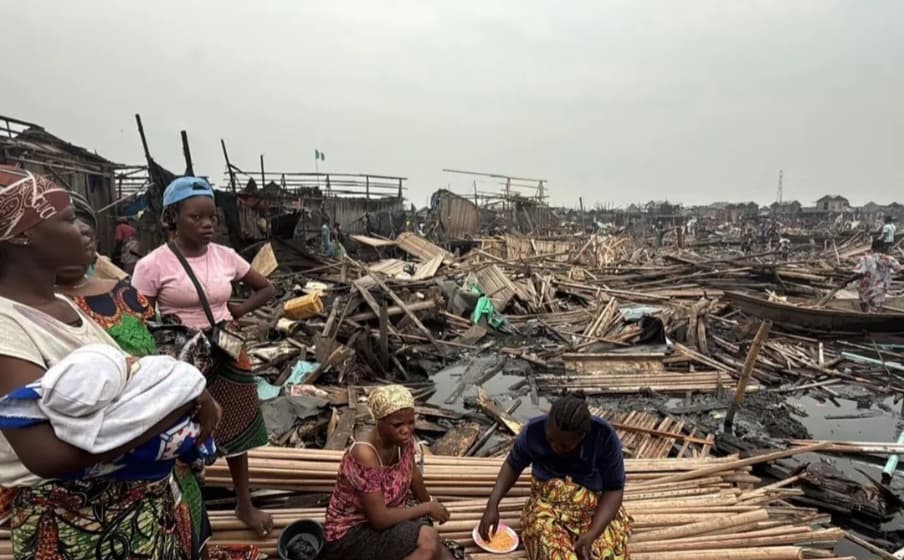
Makoko Is being demolished.
To some people, this sounds like good news. They call Makoko an eyesore. They say no human being should live on water, inside wooden houses, surrounded by waste. They call the demolition “development.”
But for the people who live there, Makoko is not a project,it is home.
Makoko did not appear by accident. Families have lived there for generations. Fishermen who wake before dawn. Women who sell fish and food. Children who learned to swim before they could write their names. Life on water became normal, not because it was easy, but because there was nowhere else to go.
No proper plan was made for them. No real housing policy included them. So they adapted. They built with what they had. They survived.
Over the years, many people came—NGOs, journalists, researchers, and tourists. Makoko became famous. Stories were told. Pictures were shared. Money was raised in its name. But for the people who live there, very little truly changed.
Now bulldozers have arrived.
And the big question is not about buildings.
It is about people.
If Makoko is “too bad to exist,” where are the people supposed to go?
Were they given new homes?
Were they paid compensation?
Or are they simply being pushed away to make space for expensive projects?
Some people say:
“You cannot modernize Lagos and keep places like Makoko.”
Others say:
“This is not development. This is displacement. You don’t fix poverty by destroying the poor.”
But there is another truth we must face:
Makoko people are not lazy.
They are not criminals.
They are workers,fishermen, traders, mothers, fathers, and children with dreams.
They deserve clean water.
They deserve safe houses.
They deserve schools, clinics, and dignity.
Not sudden homelessness.
Development that destroys lives is not progress.
A beautiful city built on broken families is not a success.
If Makoko must change, it should change with the people, not without them.
If Lagos wants to be a global city, then it must also be a human city.
So let us talk honestly:
Do you support the demolition of Makoko?
Do you see it as development or land grab?
And if you were living there, what would you want the government to do differently?
Because development should not erase people.
It should carry them forward.