Continuation 👇
Part Three
What Did Not Exist in Traditional Times.
In traditional Yorubaland, there was no concept of:
suspension letters
salary cuts by councils
banishment by elected politicians
removal through courts or administrative panels
These practices were unknown to our ancestors.
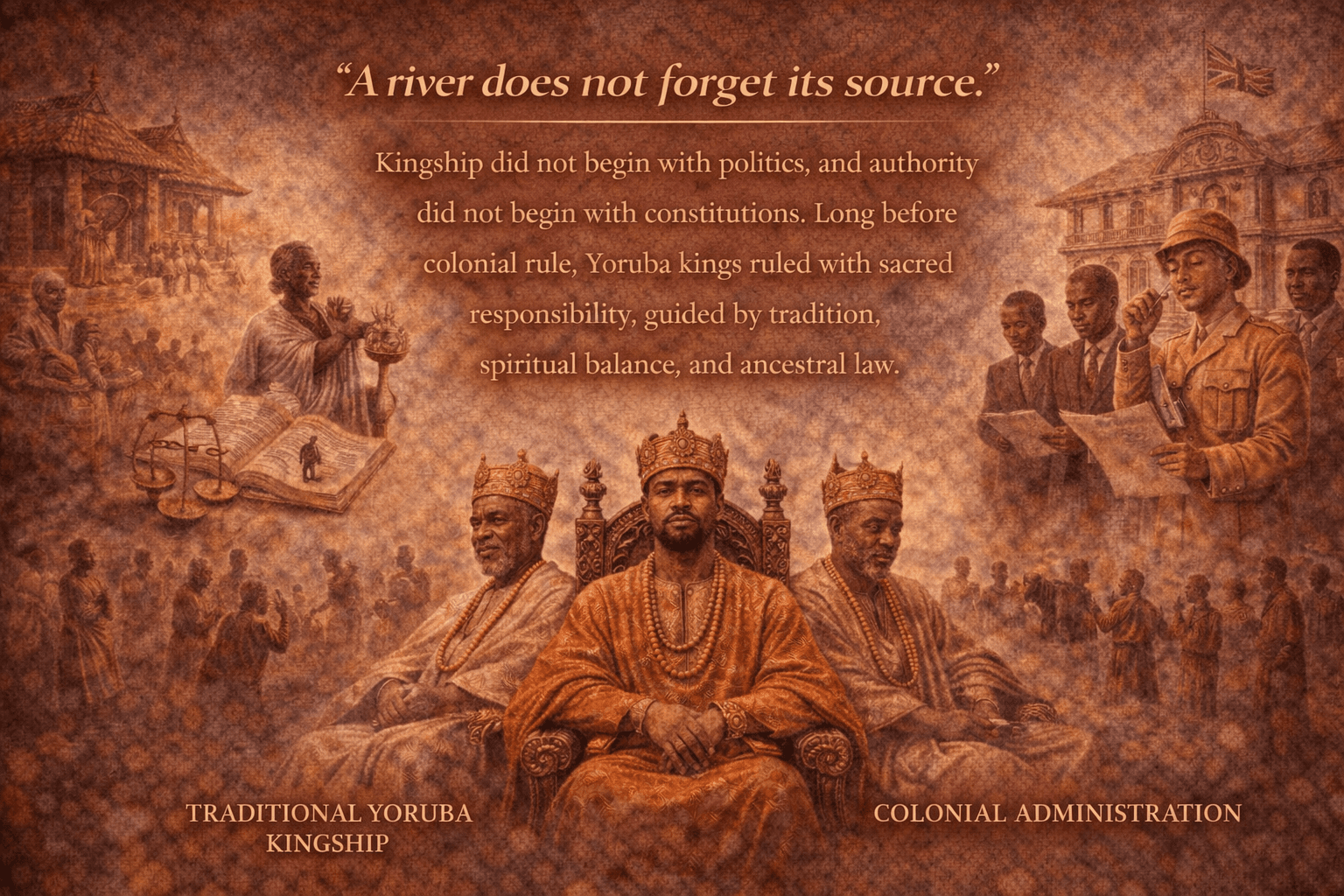
They arrived with colonial indirect rule, the native authority system, and later regional governments. These systems reduced the power of kings and placed them under political control.
Part Four
How Colonialism Changed Everything.
Colonialism separated spiritual authority from political power. Kings were reduced to what are now called traditional rulers under government supervision. Laws were introduced that made it possible to remove a king without following ancestral or ritual process.
This is why today, it has become possible for councillors or political appointees to tell a Kabiyesi to stay at home, and it happens. Such an act would have been unthinkable in Yorubaland before the twentieth century.
Part Five
Kingship Under Modern Politics.
Today, politicians rule over kings to the extent that they can suspend or dethrone them. Becoming a king now is sometimes influenced by connections rather than culture. Whoever has stronger political backing gets installed.
We have seen situations where one government installs a king, and when another government comes into power, the same king is removed and replaced by someone from their own circle. This practice is slowly destroying our traditions and weakening the sacred institution of kingship.
It is painful and ridiculous that anyone can shake a Yoruba throne simply because they are influential or connected.
Part Six
A Call to Remember and Reclaim Our Culture
At Omolola Talkstv, we believe this is not right. A king stands above politicians, whether president, governor, or councillor. In some parts of the world, such as England, the king still holds authority above political offices. This shows that tradition and governance can coexist without destroying culture.
We have a long way to go. We must continue to talk about kingship before politics and kingship after politics. We must understand how kings were removed traditionally and how colonial and modern systems altered that sacred balance.
This understanding prepares us to fully grasp the stories of Alaafin Adeniran Adeyemi II, Alaafin Aole, and Oba Kosoko of Lagos, whose lives reflect different moments in the transition from sacred kingship to colonial and political control.
Join Omolola Talkstv to read, learn, and understand more about our culture.
Because culture must not be sacrificed on the altar of politics.
✍️
Omo'ba Omoluabi
Omólola Adepeju