
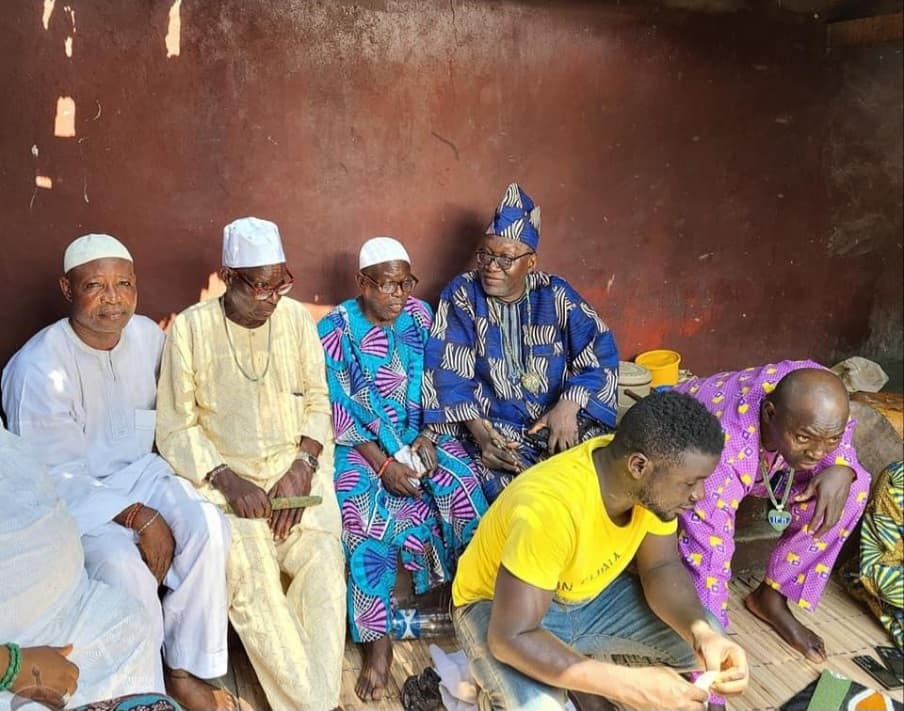
What is Ogboni?
Ogboni is one of the oldest and most respected political and spiritual institutions in Yoruba civilization. Far from the misconceptions that surround it today, Ogboni was originally a council of trusted elders responsible for maintaining justice, preserving tradition, and ensuring balance within society.
At its core, Ogboni represents a system built on wisdom, accountability, and moral responsibility. It was not created for secrecy or fear, but for order, stability, and truth.
Ogboni is deeply connected to Ilẹ̀, meaning the earth. In Yoruba thought, the earth is not just land but a sacred witness to truth, a symbol of stability and the foundation of life itself. This connection gives Ogboni its authority as a custodian of justice and ancestral wisdom.
Ogboni in Yoruba Governance
In traditional Yoruba political systems, governance was never designed to be absolute. Power was shared, checked, and balanced through institutions, and Ogboni played a central role in that structure.
The king, known as the Ọba, ruled the kingdom. However, his authority was not unchecked. The Ogboni council existed to ensure that leadership remained just and aligned with the moral expectations of the people and the traditions of the land.
Ogboni was not separate from the government. It was part of governance itself.
When necessary, the council had the authority to question decisions, intervene in matters of injustice, and restore balance if power was abused. This shows clearly that Yoruba political systems were highly sophisticated, operating on principles of accountability long before modern systems of governance became widely known.
In essence, Ogboni stood as a moral compass within the political structure, ensuring that no ruler placed himself above truth or tradition.
The Philosophy Behind Ogboni
The foundation of Ogboni lies in deeply rooted Yoruba values. It represents key principles such as truth, justice, fairness, and balance.
Ogboni embodies:
Òtítọ́ — truth
Òdodo — justice
Ìdájọ́ — fairness and judgment
Reverence for ancestors and tradition
Through these values, Ogboni reminds society that leadership is not about control but about responsibility.
In Yoruba philosophy, power does not belong to one individual alone. It belongs to the people, the land, and the collective heritage of the community. Ogboni exists to protect that balance.
Why Ogboni is Misunderstood today
In modern times, Ogboni has been widely misunderstood and often misrepresented. This misunderstanding did not originate from Yoruba tradition itself but from external influences and changing societal perspectives.
Colonial interpretations and missionary narratives played a major role in reshaping how indigenous institutions were viewed. Practices that were not openly accessible to outsiders were often labelled negatively simply because they were not fully understood.
Over time, secrecy surrounding certain aspects of Ogboni further contributed to suspicion. As a result, many began to associate Ogboni with terms such as a “mystical cult” or a “dark society.”
However, these labels do not accurately reflect their original purpose.
Ogboni was not created as an instrument of evil. It was a structured institution designed to uphold justice, maintain order, and preserve the ethical foundation of society.
Like many ancient institutions across the world, its depth and symbolism require understanding, not assumption.
Ogboni is Not Evil: Understanding the Truth
It is important to address this clearly. The idea that Ogboni is inherently evil is a modern misconception that has grown over time due to lack of knowledge and cultural distortion.
Originally, Ogboni functioned as a stabilizing force within Yoruba society. It ensured that leaders remained accountable, traditions were respected, and justice was upheld.
Any institution can be misunderstood when removed from its original context. What must be understood is that Ogboni, in its authentic form, was built on principles that align with fairness, truth, and societal well-being.
It is not the secrecy that defines Ogboni but the values it protects.
Understanding this distinction is key to reclaiming the true narrative of Yoruba heritage.
The Symbolism of Ogboni
Ogboni is rich in symbolism, most of which centres around the earth and ancestral authority.
The earth represents truth because it can not lie. It represents stability because it holds all things in place. It represents continuity because generations come and go upon it.
By aligning itself with Ilẹ̀, Ogboni draws its authority from something greater than individual power. It reflects the belief that justice is not created by humans alone but guided by deeper principles rooted in existence and ancestry.
This symbolism reinforces the idea that leadership must always be grounded in truth and accountability.
Final Reflection
Ogboni is not a mystery to be feared but a heritage to be understood.
It represents a time when governance was guided by wisdom, when power was balanced by accountability and when society placed truth above individual authority.
To misunderstand Ogboni is to miss an important part of Yoruba civilization.
To understand it is to recognize the depth, intelligence, and structure that has always existed within Yoruba systems of governance.
“If you’ve ever wondered whether Ogboni is evil, read our next article where we address the misconceptions.”