When Africans Call Africans “Foreigners” – A Painful Reflection.
There is something deeply painful about what is happening in South Africa right now. Not just because of the attacks or the tension, but because of what it represents. Africans turning against Africans. Brothers and sisters suddenly becoming “foreigners” in a land that shares the same blood, the same history, the same struggle.
It is hard to understand how we got here.
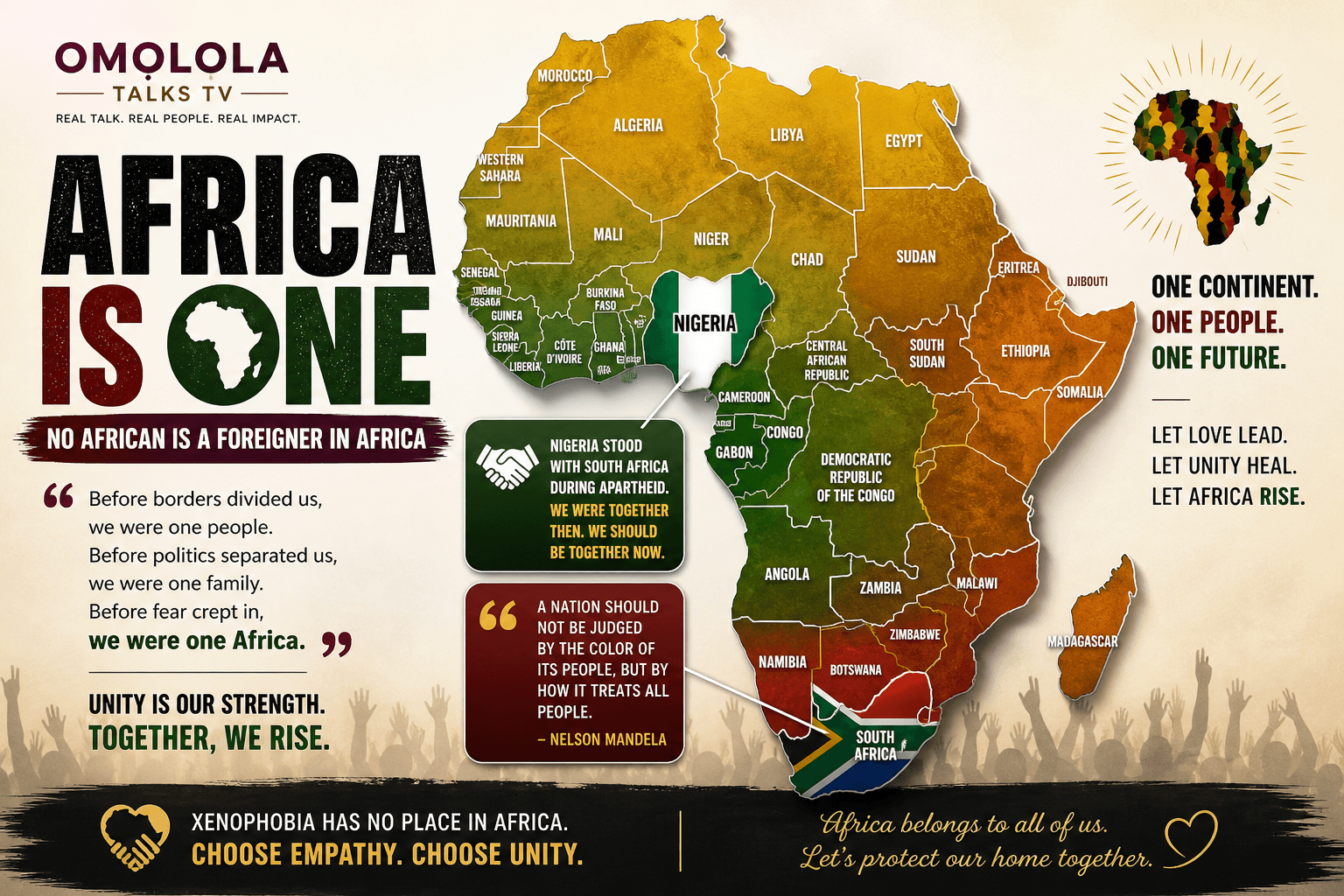
There was a time when Africa stood together. During apartheid, Nigeria did not look away. Nigerians stood up, spoke out, and gave what they had to support the freedom of South Africa. It was not about nationality. It was about humanity.
Even Nelson Mandela himself acknowledged this. He recognized Nigeria’s role, not as outsiders, but as part of a shared fight. That history is real. It happened. And it should mean something today.
But today, we see a different story unfolding.
Nigerians and other Africans are being targeted, blamed, and labeled as outsiders. People who came to hustle, to survive, to build something for themselves are now being seen as the problem. Shops are attacked. Lives are disrupted. Fear spreads.
And the truth is, this pain is not just physical. It is emotional. It is psychological. It is the kind of pain that makes you question your place in your own continent.
At the same time, many people back home are watching, waiting, and asking one big question.
Where is the voice of the Nigerian government?
So far, there has been silence, or at least not enough has been said to match the weight of what is happening. And that silence is loud. Nigerians in South Africa are not just numbers. They are people. They are families. They are dreams trying to survive in a foreign environment that should not feel foreign.
When situations like this happen, people expect leadership. They expect reassurance. They expect strong words that say, “Our people matter, and we will not ignore what is happening to them.”
Silence creates uncertainty. It makes people feel abandoned.
But even as we speak about South Africa, we must also be honest with ourselves as Nigerians.
Respect is not only demanded. It is built over time.
The way a country is run reflects how its people are treated outside its borders. When there is instability, corruption, insecurity, or lack of structure at home, it affects how others see us. It should not be so, but that is the reality of the world we live in.
Nigeria has everything it needs to command respect. The talent, the culture, the strength, the global influence. But these things must be supported by good governance, accountability, and a system that truly works for its people.
If Nigeria becomes stronger internally, it becomes harder for any country to look down on Nigerians anywhere in the world.
Now the emotional question many people are asking is this
Should Nigerians retaliate?
Because the truth is, there are South Africans living peacefully in Nigeria. In Lagos, in Enugu, and in many other places. They live, they work, they go about their daily lives without fear.
But retaliation is not the answer.
If Nigerians begin to treat South Africans the same way some Nigerians are being treated abroad, then we become part of the same problem we are condemning. We lose the moral ground. We lose the difference that should define us.
Nigeria has always been seen as a leader in Africa. Leadership is not shown through revenge. It is shown through restraint, through wisdom, and through doing what is right even when emotions are high.
The real solution is not hate. It is accountability, diplomacy, and unity.
Because at the end of the day, the real enemies are not Nigerians or South Africans. The real challenges are poverty, unemployment, inequality, and systems that are not working for the people.
Turning against each other will never solve those problems.
This is a moment for Africa to reflect.
A moment to ask hard questions.
A moment to remember who we are.
Before we were divided by borders, we were one people. And if we continue to forget that, we will keep repeating the same painful cycle.
For Omolola Talks TV, this is not just a story. It is a call to awareness. A call to unity. A call to do better.
Because Africa belongs to all of us.